
Perspective
Toyota manufactures learning (and cars). Lessons for your software factory.

11 min read
We talk about software factories and picture finished products rolling off the line without a human hand in the mix. The picture is useful. But the history of real factories carries a warning for us.
Efficiency can become dangerously disconnected from demand.
Detroit proved this. Toyota understood this deeply and avoided it. Toyota's production system is famous for making cars. But, beyond this, it was designed to produce learning; about what to build and how to build it.
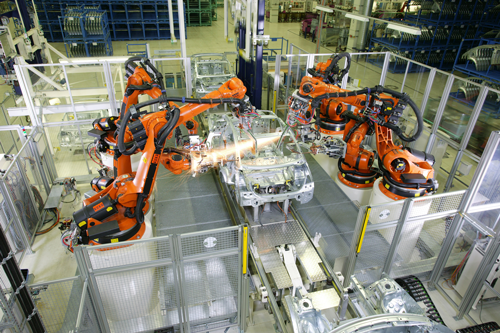
Detroit built the wrong cars, faster
By the 1970s, Detroit had built one of the most sophisticated production machines in the world. The Big Three knew how to manufacture automobiles at enormous scale. Their plants, supply chains, engineering organizations, dealerships, and financial systems had all evolved around the economics of mass production.
Then customers changed.
The oil shocks transformed what Americans valued in a car. Higher gasoline prices and the memory of gas lines weakened demand for the large, powerful cars Detroit had been optimized to produce. Buyers shifted sharply toward smaller and more fuel-efficient vehicles. Japanese and European manufacturers were already good at making those. After the 1979 oil shock, imports jumped from less than 18% of the U.S. market in 1978 to 22% in 1979 and 26% in 1980. U.S. manufacturers could sell the small cars they made. They simply did not have enough capacity or the right product mix to satisfy the new demand.
Detroit's response is where the story becomes relevant to AI.
General Motors concluded, in significant part, that it had a production problem. Under CEO Roger Smith, GM launched an enormous modernization effort around computers, robotics, automation, and new manufacturing technology. Smith himself wrote in 1985 that GM had invested about $40 billion in new U.S. plants and equipment in the first half of the decade. He boasted that no American industry was more involved in computers and robotics. (Congressional Record)
It was an extraordinary technological undertaking.
And it did not solve GM's competitive problem. GM's share of the U.S. car and truck market fell from 44.5% in 1980 to 35.8% by 1990. Contemporary accounts pointed not just to manufacturing costs, but to quality problems, undifferentiated "look-alike" products, and relentless competition. Some of GM's most automated factories became notorious for expensive equipment that failed to deliver the promised gains.
GM had attacked the cost and mechanics of making cars without solving the more important problem, which was making the right cars.
The business problem hidden inside automation
Automation improves a production function. It does not tell you what customers value. Worse, heavy mechanization can make the organization less responsive to that information.
Here is how that happens. Capital-intensive factories reward utilization. Long production runs amortize expensive equipment. Standardization reduces unit costs. Forecasting replaces responsiveness. Once the machine has been built, enormous economic pressure develops to keep the machine running.
The organization becomes extraordinarily good at pushing supply. It stops learning.
Toyota's advantage was not that Japan had better robots. Toyota built a different system of production, and the system was organized around learning. The "Just-in-Time" approach was explicitly organized around producing what was needed, when it was needed, and in the amount needed. That is a rule about listening to demand, not a rule about speed. Jidoka paired automation with human judgment so that defects and abnormalities were surfaced inside the process rather than discovered at the end. That is a rule about learning from every unit, not a rule about inspection. Toyota described these two ideas, Just-in-Time and "automation with a human touch," as the foundations of its production system.
The contrast became visible at NUMMI.
GM's Fremont, California plant had been one of the company's worst-performing facilities. It was plagued by poor quality, low productivity, absenteeism, and adversarial labor relations. GM closed it in 1982. Toyota and GM reopened essentially the same factory with largely (85%) the same workforce, but under Toyota's production and management system. Within five years, the plant was operating at efficiency levels comparable to Japanese factories. Contemporary analyses also found dramatic improvements in quality and productivity. (U.S. Office of Technology Assessment)
Same building. Same people. Different system for learning.
The warning for the software factory
AI is making the production of software astonishingly cheap. Agents can implement tickets, write tests, refactor systems, and increasingly execute entire development loops. It's tempting to measure the resulting factory by throughput, e.g., features shipped, tasks completed, agents supervised, or engineering hours eliminated.
That would be Detroit's mistake.
The limiting factor in software is no longer the ability to produce running code. It is the ability to determine which software deserves to exist. Automation makes that problem more important, not less.
When the cost of production falls, the cost of being wrong does not disappear. It moves. The organization accumulates features customers do not use, products nobody loves, abstractions nobody understands, dependencies that must be maintained, and operational complexity that persists long after the agent that created it has disappeared.
Detroit ended up with dealer lots full of unwanted cars. The software equivalent is repositories full of perfectly functional software that nobody needed.
So the software factory should not be designed primarily as an automated assembly line. It should be designed as a demand-sensing system. Customer behavior pulls work into the factory. Small batches make mistakes cheap. Production and customer learning stay tightly coupled. Agents surface problems rather than hide them. Humans can stop the line. The system continuously asks not merely can we build this? or even how cheaply can we build this? but what did we learn from the last thing we built, and does the next thing still deserve to exist?
Detroit discovered that automation is not a substitute for understanding the customer. It is a multiplier on whatever understanding, or misunderstanding, you already have.
The danger of the AI software factory is not that it fails to produce enough software. It is that it becomes exceptionally good at producing software the market never asked for.
That was the 1980s. Is Toyota still Toyota?
It is fair to push back on a forty-year-old story. Robots have gotten very good since NUMMI. If Toyota had quietly become a lights-out operation, the lesson would be dead, and the software factory would be right to ignore it.
So I looked at what Toyota is doing in 2026. The short version is that Toyota has automated a great deal without abandoning the logic from the story. If anything, the current version of Toyota makes the software lesson sharper.
Humans are still very visibly present in Toyota factories. They assemble cars, inspect quality, respond to abnormalities, perform specialized work, maintain equipment, and continuously redesign the production process. Toyota's Indiana plant has more than 7,380 employees today. Workers operate alongside robots and also program the robots used for jobs such as welding and painting. (Toyota Pressroom)
But the type of human work is moving upward.
At Toyota's Takaoka plant, one previously manual job involved workers looking upward and applying roughly 30 adhesive patches to each vehicle body. Toyota is automating that with robots. The workers are not discarded from the system. The people who knew the job are learning to train and operate the robots. Similarly, autonomous mobile robots are taking over the work of parts transport, and Toyota says the people who previously drove forklifts and transporters are moving toward designing and improving the logistics systems that the robots operate within. (Toyota Times)
There are even genuinely lights-out pieces of the factory now. At Toyota's Kamigo engine plant, a piston subassembly line that went live in January 2025 took a process from three operators to zero. Robots perform the entire operation. But Toyota noted that, at least at that plant, this was the exception. No other line there had reached full automation. (Toyota Times)
And Toyota is moving further. In 2026, its Canadian operation began leasing a small number of Agility Robotics humanoids after a year-long test. Their assigned work is telling. They transport bins and components, which is the repetitive physical movement that conventional automation handles badly because the environment was designed around humans. (Semafor)
Here is how I would describe the evolution.
| Older Toyota | Toyota in 2026 |
|---|---|
| Human performs operation | Robot increasingly performs operation |
| Human notices defect | Machine increasingly detects defect |
| Human moves material | Mobile robot increasingly moves material |
| Human directly adjusts process | Human designs and improves the automated process, and trains the robots |
| Human craftsmanship creates the standard | Human craftsmanship is used to teach the machine the standard |
| Human watches machine | Machine watches itself, and a human handles abnormalities |
| Human does kaizen | Human still does kaizen |
That last row is the one that connects 1985 to 2026.
Toyota's official description of its production system in 2026 still explicitly distinguishes jidoka from ordinary automation. The point of jidoka is that the machine should run by itself and stop itself when something is wrong. A person does not have to stand there supervising it. The person's attention gets pulled in when judgment is useful. (Toyota Global)
Toyota has become unusually explicit about this as AI and robotics improve. Its 2025 Integrated Report says automation should be "centered on people," rather than ordered from above as a way to reduce headcount. Toyota's current management language says that as automation advances, the skills of the people using it become more important, not less. (Toyota Global)
There is some corporate philosophy in those statements. But the plant examples show that it is more than a slogan.
What has not changed
This is the most important refinement to the Detroit story.
Toyota's insight was never "don't automate too much." Toyota is happy to eliminate a human from a production operation. That is jidoka working properly. A machine that can operate and monitor itself should not need a human babysitter.
The insight is this:
Do not confuse automation of the work with automation of the system's intelligence.
What Toyota is extremely reluctant to automate away is the human's role in understanding and improving the system. Humans still do the following:
- decide what constitutes good work
- recognize classes of problems the machinery was not designed for
- improve processes through kaizen
- teach tacit skills to machines
- redesign the interaction between processes
- respond to exceptions
- stop the system when reality disagrees with what the system expected
Toyota's Takaoka plant maintains training "dojos" for manual skills even as robots take over more operations. The argument is that you need people who understand the craft at an even higher level if they are going to teach that craft to robots. (Toyota Times)
That applies almost directly to agentic software.
What this means for the 2026 software factory
The weak version of this argument would be that Toyota kept humans building cars, so software companies should keep humans writing code. That is wrong, and it undercuts the lesson.
The strong version is this:
Toyota increasingly lets machines make the car. It does not let the machines own the production system.
That is a much more provocative model for the software factory.
Let agents write the code. Let agents write the tests. Let agents perform migrations. Let agents investigate failures. Let agents operate routine workflows without a human staring over their shoulders. A Toyota reading of AI would probably say that requiring a human to review every agent action is itself a form of waste.
Then ask the question Detroit never asked. What does the human do with the attention automation just gave back?
The Detroit answer is to manage more output. Give one engineer 20 agents. Increase utilization. Produce ten times as many features. That is Roger Smith's $40 billion, spent again on tokens.
The Toyota answer is to move the human upstream into the learning loop. Understand the customer. Observe what actually happened. Investigate abnormalities. Change the standard. Decide what should be produced next. Improve the factory itself.
Which brings the two halves of this story together.
The lesson from Toyota is not that humans must remain on the assembly line. It is that as humans leave the assembly line, they must move closer to the problem, not farther from it.
Automation should remove humans from production, not from understanding.
Toyota has spent seventy years building a factory whose main product is learning. The cars are what the learning looks like when it leaves the building. Build your software factory the same way, and the code will take care of itself.